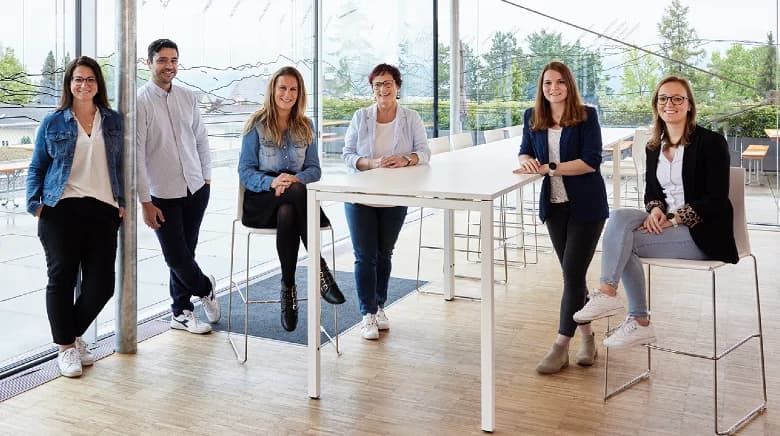
The story behind the world’s smallest CO2 sensor
Last year, we launched more new products than ever before in the history of our company. And with the launch of the world’s smallest CO2 sensor in early 2021, we achieved a real coup. It wasn’t just the sensor’s size – a mere 10.1 x 10.1 x 6.5 mm3 – which represented an absolute novelty in CO2 sensor technology, but also the photoacoustic measuring principle. However, as with all of our sensors, it resulted from a long history of numerous development steps with major contributions from employees across the company.
Like every success story, this one started with a crazy idea. In this case, it was that of Thomas Uehlinger, who, as a development engineer, set his sights on producing the world’s smallest CO2 sensor based on the photoacoustic measurement principle at the beginning of 2016. Without knowing for sure whether a CO2 sensor could actually measure accurately using this principle, Thomas set to work on the first prototype. Equipped with his ambition, a love of tinkering as well as high-tech components and a handful of commercial materials from the hardware store, he soon had his first breakthrough. His initial prototype was already producing measurement results on a par with conventional CO2 sensors. At that time, it was hardly possible to speak of the world’s smallest sensor, but the groundwork had been laid and it was decided to pursue the project further under Thomas' lead. Working with a specially convened project team, he succeeded in improving the sensor with each iteration of the prototype. These developments had to reflect not just purely technical aspects, but the needs of potential customers as well.
“As Project Leader, I coordinated the development of the sensor, while always aiming for optimal fulfilment of the different requirements of the market with the technical possibilities available.”
Thomas Uehlinger, Senior Project Leader
Thomas and his department received support from Product Manager Marco Gysel. With responsibility for product strategy, Marco searched the market for potential areas of application and corresponding customers for the new sensor in parallel with the development team. The results of his market analysis then fed directly back into the development process.
“If we don’t focus on making sure our product best meets our customers’ needs, the worst case scenario is that we develop a unique sensor that nobody wants to use.”
Marco Gysel, Product Manager
A major challenge in the miniaturization of the CO2 sensor was defining the type of light source for the measurement process. Conventional CO2 sensors are based almost exclusively on simple light bulbs, which are too large for the desired sensor size. This is where development engineer Sebastian Raab and his department of MEMS technology came in, dedicated to the development of an alternative light source. After extensive research and numerous trials, they found a solution that had never been tried in the field of CO2 sensing. This allowed the sensor to be miniaturized to its final size of 10.1 x 10.1 x 6.5 mm3.
“I usually start by collecting ideas: What’s in the literature? What has already been applied? What do we use at Sensirion? After that, it’s mainly about finding the best combination of these components. The goal is always to find the simplest and cheapest solution. A complex solution may be feasible in the development stage, but it represents a major disadvantage when you’re producing hundreds of thousands of units.”
Sebastian Raab, Senior R&D Engineer
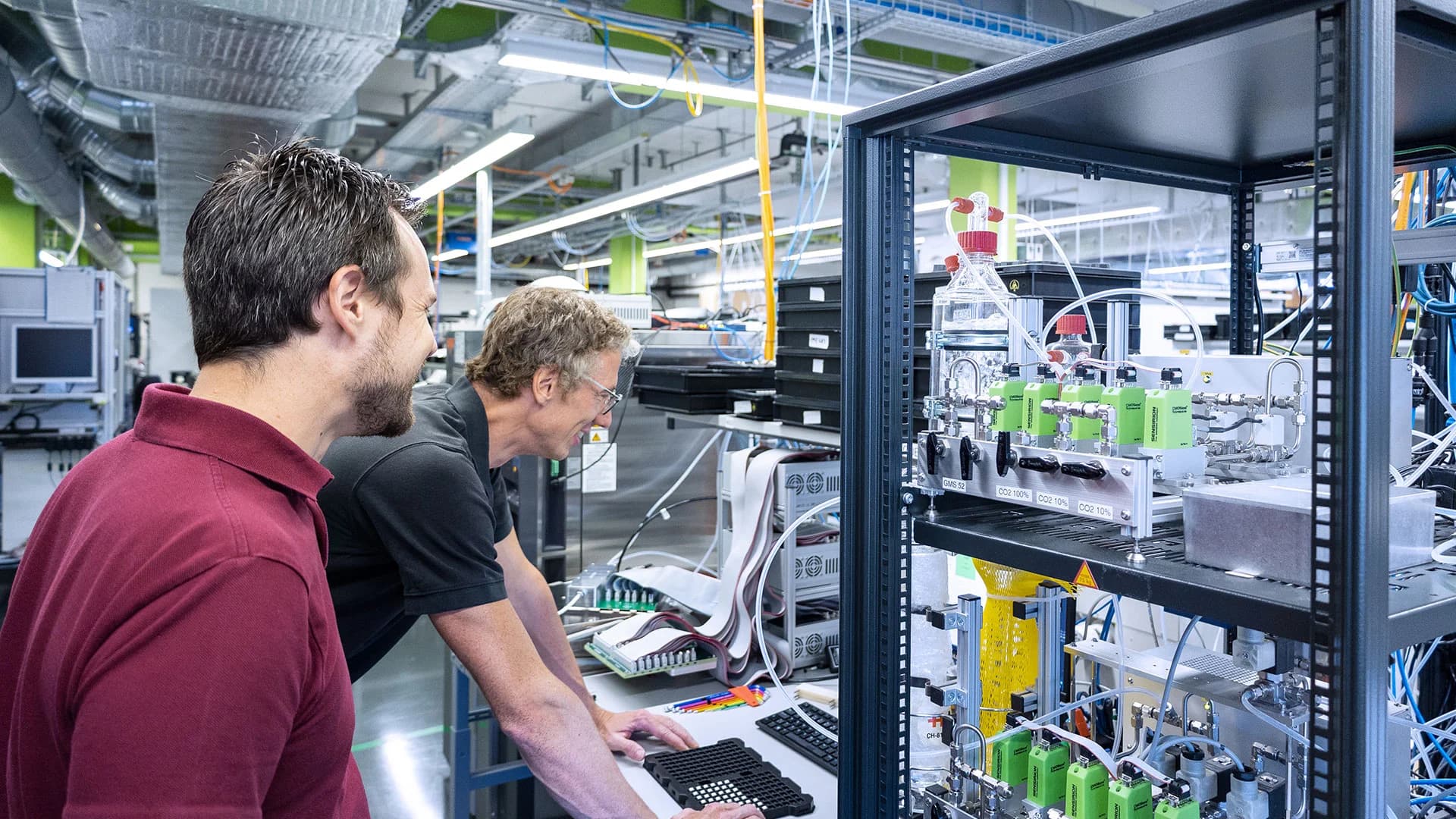
Of course, a sensor does not work without the appropriate circuit. That is why the Application-Specific Integrated Circuit (ASIC) department was involved in the development process early on. However, the development of the corresponding microchip is one of the most cost-intensive development steps. With every additional revision in this phase putting extra pressure on the development budget, good coordination between all departments was crucial.
Meanwhile, Key Account Managers like Stephan Stutterheim were already taking care of the acquisition of customers from all over the world. It’s a process that can’t wait until the completion of the final product; in fact, it starts when the first functional sensor is available. Stephan and his colleagues gathered valuable input in their customer consultations, which they passed on to the Project Leader and the Product Manager, which meant the sensor reflected current customer requirements at each stage of its development.
“My area of responsibility is the Chinese market. So, I frequently visited China during the development phase to show potential customers the benefits of our new CO2 sensor and gather valuable feedback in the process.”
Stephan Stutterheim, Key Account Manager
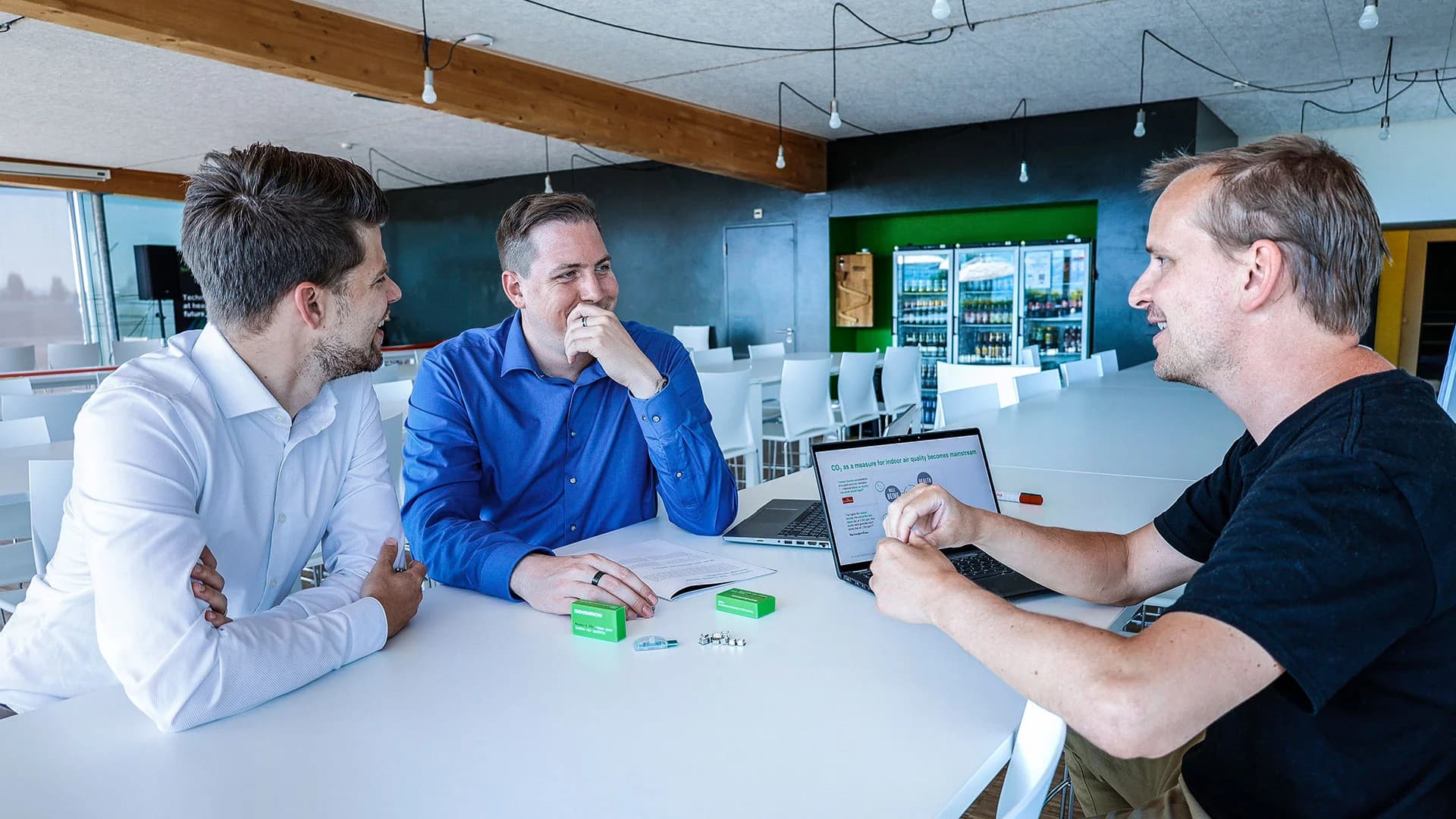
With the development phase complete, Product Manager Marco Gysel put together a task force for the market launch. He was joined in the launch team by Key Account Manager Stephan Stutterheim and Philipp Seidel, an experienced marketing project leader. Together they defined a marketing strategy to promote the sensor by zeroing in on potential customers via various communication channels.
“With cross-media marketing measures such as live demos at trade fairs, technical articles, interactive webinars, videos and advertising on social media, we were able to ideally position the CO2 sensor on the market. This succeeded in generating significant resonance among our customers.”
Philipp Seidel, Project Leader Marketing & Communication
In parallel with these developments, the entire production was being prepared for the manufacturing of the new sensor. Program Director Marcel Koller was responsible for planning the whole production process. The challenge of such a “ramp-up”, i.e. the increase of capacities for mass production, lies in the most reliable and cost-efficient production of high quantities. Marcel’s first task was to determine the materials and the volumes required for mass production and which suppliers they could be sourced from, while also figuring out whether machines could be reused or if new dedicated machines needed to be developed. He also assisted the Process Engineers in designing the individual production steps that would later be carried out by the production staff. This kind of process planning is essential for functioning production, but for smooth operations it always needs testing in practice.
“It is important to produce high volumes early on so that any problems that only arise with large quantities can be discovered and solved early on. For example, a bug that occurs in every 10,000th sensor won’t be detected until we’ve already produced a few 100,000 units.”
Marcel Koller, Program Director
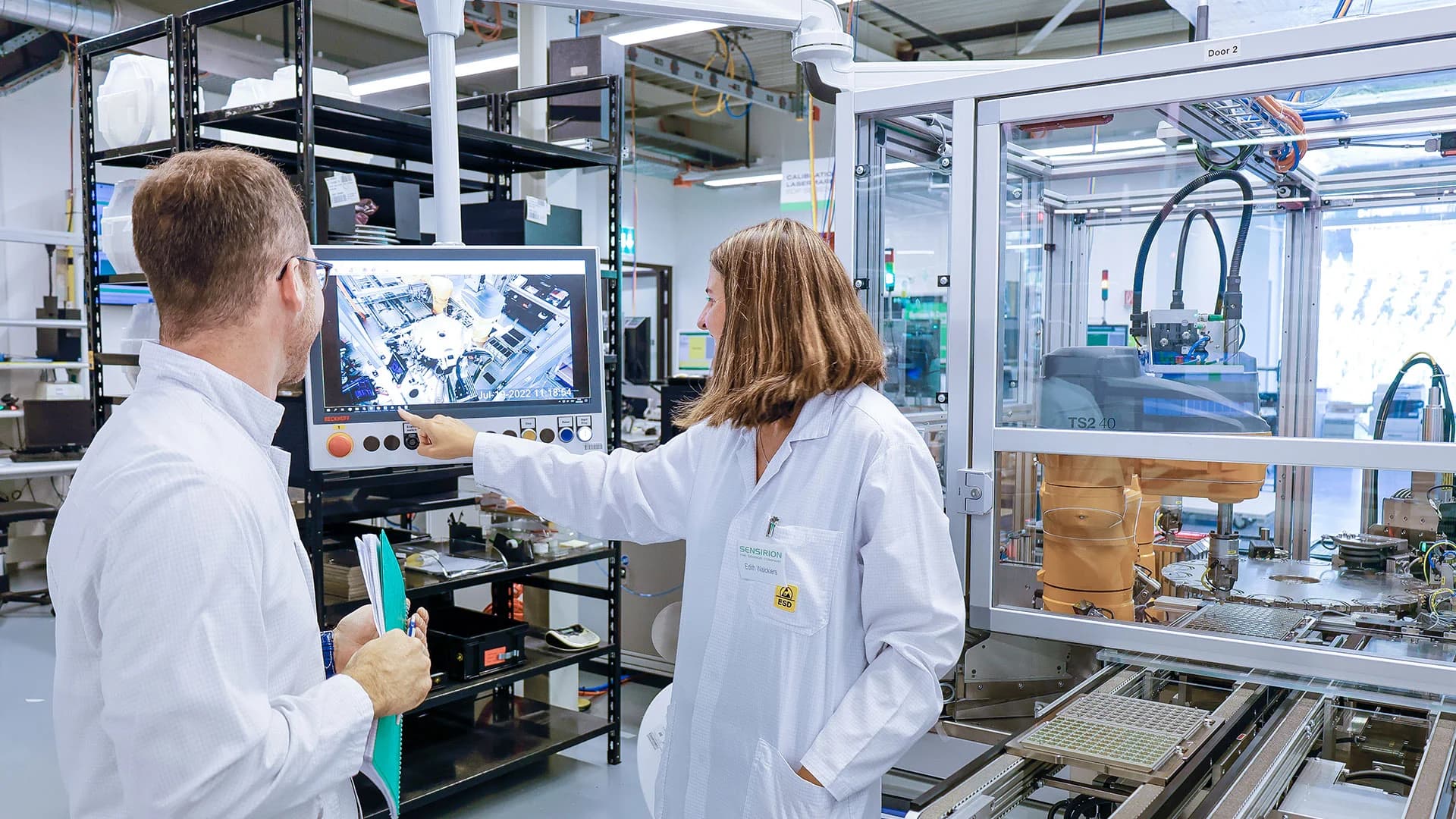
Once production has started, Process Integration Manager Edith Walckiers ensures optimal implementation of the production process. In part, this involves continuously checking that all the scheduled machines are running smoothly as well as training the production staff. But with such high demand for the new sensor, production had to start even before the actual process design was finalized. This was a major challenge, but one Edith’s production team easily overcame thanks to their agility and teamwork.
“With demand for the sensor increasing on an almost weekly basis, we had to temporarily integrate existing machines into the new production process. Managing that kind of increase in capacity required good collaboration across all departments, and once again that worked out really well.”
Edith Walckiers, Senior Process Integration Manager
In January 2021, around five years after the initial idea, the first CO2 sensors rolled off the assembly line to be shipped to our customers around the world. Around one and a half years later, our sensor is still a great success. The smallest CO2 sensor on the market is one of our most popular products, and it’s already being used in a wide variety of applications such as air conditioning, ventilation systems and indoor air quality monitors. Naturally we’re proud of this market success, but we’re even prouder of the story that takes us from the original idea to the sought-after end product. Because it is the story of numerous employees from a wide range of departments coming together and using their own initiative, their joy of mastering technical challenges as well as teamwork. It is precisely these stories that define us at Sensirion and our products.