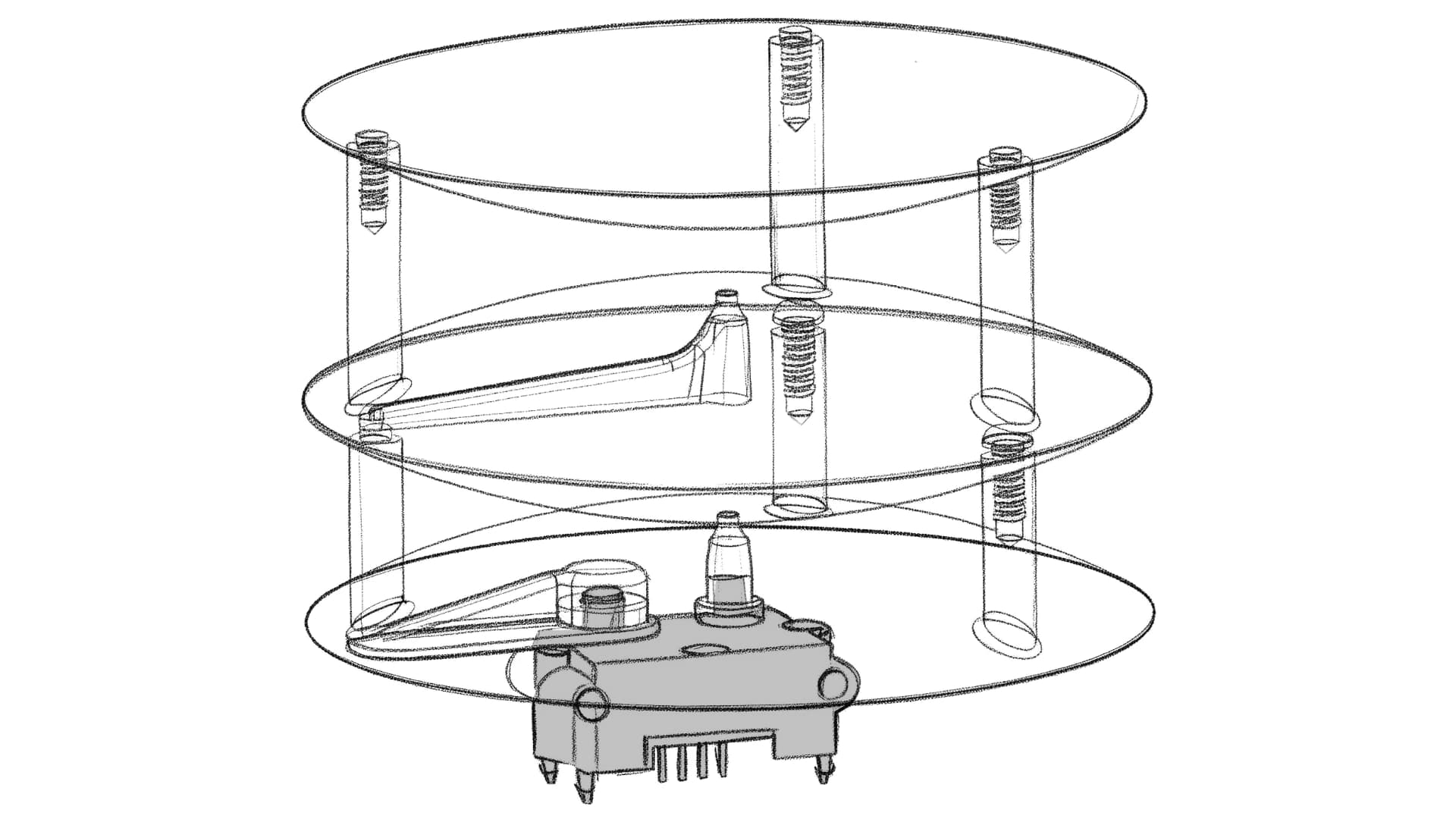
The combination of the Bernoulli principle and a high-precision differential pressure sensor can be used to measure air mass-flow in a blower or centrifugal fan. This approach has significant potential for improving both accuracy of constant flow blowers and cost efficiency across a range of airflow applications.
Principle of operation based on the Bernoulli effect
The Bernoulli effect describes the inverse relationship between air velocity and static pressure in a moving fluid. When airflow passes through a constricted or curved region, its speed increases and the local static pressure decreases. In the Bernoulli ring configuration, our SDP8xx differential pressure sensor measures the pressure difference between the air outlet and the ambient inlet side, producing a signal directly proportional to the airflow rate. This setup enables accurate, non-intrusive measurement of flow without physically obstructing the air stream, minimizing the risk of clogging and reducing maintenance requirements.
Sensor technology and measurement characteristics
Our SDP8xx sensor is particularly well-suited for this application due to its high sensitivity in low-pressure environments and its robust CMOSens™ thermal flow technology. The sensor integrates signal conditioning, temperature compensation, and digital calibration in a single compact device, ensuring precise differential pressure measurements over a wide dynamic range with minimal drift. The absence of moving parts guarantees long-term stability and reduces the need for recalibration or frequent maintenance.
System integration and calibration
The measured differential pressure is continuously converted into volumetric or mass flow values using a calibration model based on the system geometry and air properties. The compact geometry of the Bernoulli ring air flow measurement allows easy integration into blower housings. Its design can be complemented with filters to limit contamination ingress further enhancing robustness in dusty or particle-loaded environments.
Applications and benefits
This approach provides a scalable and cost-efficient alternative to traditional constant air-flow blowers. It is applicable in HVAC systems, where precise air-massflow monitoring can improve energy efficiency or accurate balancing of the mechanical ventilation and in industrial fans and blowers, where consistent flow measurement allows predictive maintenance and process optimization
Reliable foundation for next-generation systems
By combining a simple geometric principle with a highly sensitive solid-state differential pressure sensor, the Bernoulli ring concept provides a technically elegant and reliable foundation for next-generation constant airflow centrifugal fans, delivering robust performance and high accuracy while minimizing complexity.